
Table of contents
Your business podcast should not disappear one day after it goes live.
You already did the hard part. You booked the guest, planned the angle, recorded the episode, and published it. But for many teams, that episode gets one launch post, maybe one clip, and then it sinks into the archive.
That is why a podcast repurposing service exists.
The Short Answer
A strong podcast repurposing service should do more than turn one episode into a pile of clips and captions. It should find the parts that matter to buyers, map the proof and objection-handling moments, and turn the episode into a useful content system. If a service sells “30 assets from one recording,” you are buying output, not strategy.
Why Podcast Repurposing Is A Business Problem
Podcast attention is not small anymore. Edison Research’s The Podcast Consumer 2025 says podcast consumption hit record highs in 2025. It says 55% of people age 12 and older consumed a podcast in the last month, and 40% consumed one in the last week.
Video podcasts matter too. Edison says 51% have ever watched a video podcast, 37% watched one in the last month, and 26% watched one in the last week.
That matters for B2B teams because the audience is not only big. Edison also says monthly podcast consumers are more likely to be:
- college-educated
- higher-income
- business owners or homeowners
In plain English: serious buyers are already in this behavior.
So the problem is not whether podcasts matter.
The problem is what happens after the episode drops.
Most business podcasts contain:
- trust-building stories
- proof moments
- buyer objections
- sharp one-line insights
- clips that can pull people back to the full episode
But most teams never extract them well. The host moves on to the next interview. Marketing gets busy. The archive grows. Good ideas stay buried.
That is not a recording problem. It is a repurposing problem.
What A Podcast Repurposing Service Should Actually Do
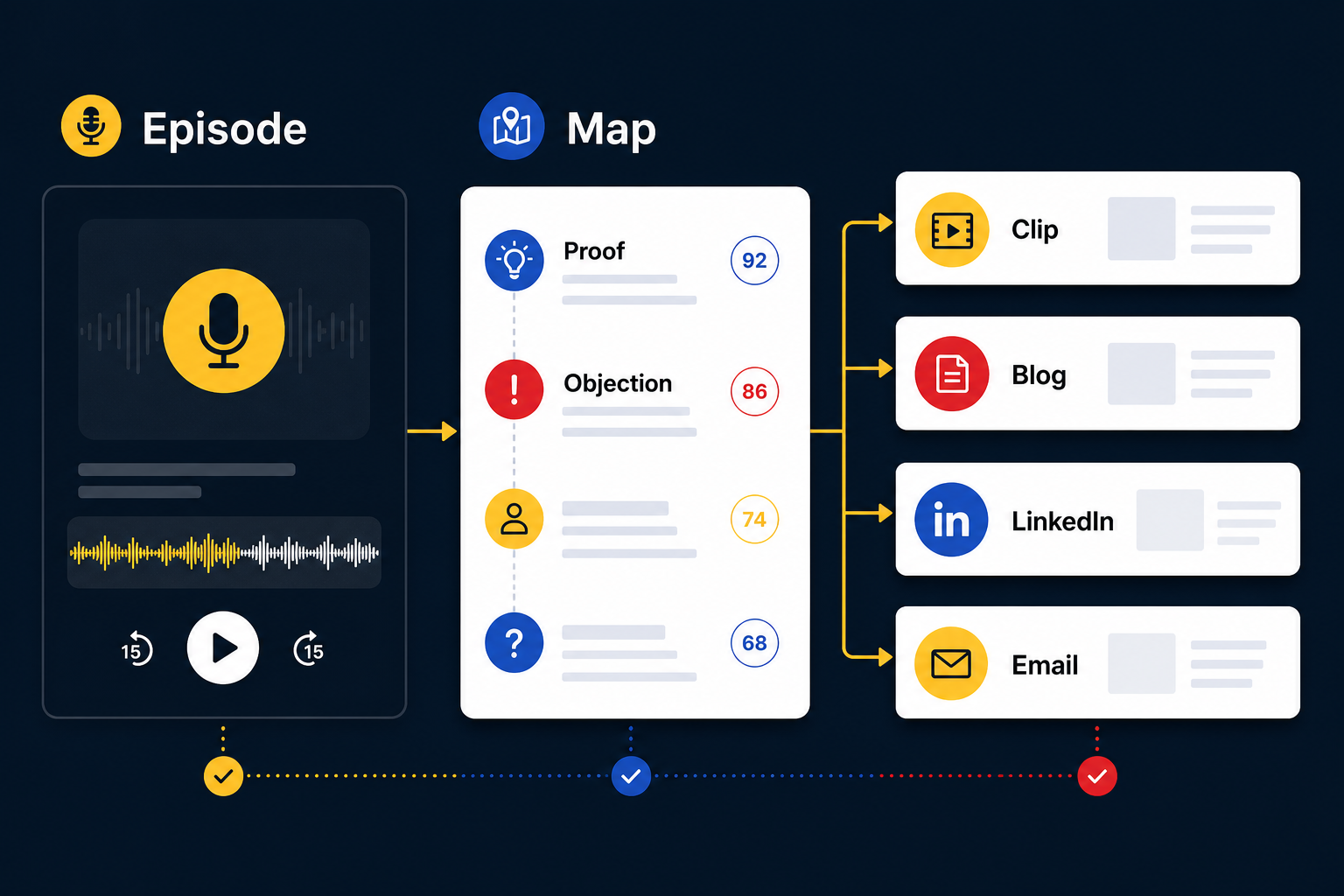
A serious podcast repurposing service starts before editing.
It should ask:
- Who is this episode for?
- What offer or sales path sits behind the show?
- Which parts teach?
- Which parts build trust?
- Which parts answer objections?
- Which parts deserve short-form distribution?
- Which parts only make sense inside the full episode?
That is the step weak services skip.
Not every minute deserves distribution.
The better path is to map the episode first. In ContentFries terms, that is a Clip Opportunity Map. You review the episode before anyone starts exporting assets. You score the moments with business value. Then you choose what becomes a clip, a blog angle, a post, or a follow-up asset.
A strong service should help you turn one episode into a content system, not a random content pile.
That can include:
- short clips for discovery
- social posts that frame one useful idea cleanly
- a blog article that expands the strongest lesson
- show notes that help listeners and search
- email or newsletter copy
- packaging notes that help the full episode perform better
The format should follow the buyer need. Not the other way around.
The Volume Trap: Promises Vs Reality
The market already shows clear demand for this kind of service.
EpisodePack is a speed-first example. Its public offer turns one episode into show notes, one SEO blog post, and five social pieces, with 24-hour delivery.
Content 10x Podcast10x is a broader extension-of-team example. Its public page includes editing, SEO blog posts, social posts, show notes, graphics, and publishing support.
Those offers prove the category is real.
But category demand is not the same as fit. It is easy to compare deliverables. It is harder to compare judgment. A service can give you clips, show notes, posts, and fast delivery, and still miss the core question: will these assets help the right buyer understand, trust, and remember your business?
AI can help with first drafts and speed. It does not replace judgment about which moments deserve distribution and which ones should stay inside the full episode.
What To Expect Before You Hire
A serious podcast repurposing service should explain its process in plain English.
Intake Should Go Beyond The Audio File
You should expect questions about:
- your audience
- your offer
- your sales process
- the role of the podcast in your business
- which channels matter most
- whether the goal is authority, leads, sales support, or all three
If the service never asks who the buyer is, it cannot judge which parts of the episode matter most.
The First Review Should Focus On Message Fit
The first review should not only be about subtitle style, layout, or where to trim two seconds.
It should answer:
- Did they pick the right moments?
- Did they keep the right framing?
- Did they preserve the original meaning?
- Do the short assets still sound like the brand?
Good repurposing starts with message fit. Polish comes after that.
Turnaround Should Match The Depth Of Work
Fast delivery is not automatically bad. In fact, for some teams speed matters a lot.
But if a service claims it can deeply understand your show, map the best moments, write strong assets, and tailor them for business outcomes in almost no time, be careful. Fast operations can be real. Careful judgment still takes work.
Scope Should Be Clear
Before you buy, you should know:
- which assets are included
- how many you get
- whether copywriting is included
- whether publishing is included
- whether revisions are included
- who owns the final files
- whether the service helps with distribution strategy or only production
Content 10x publicly includes publishing and distribution support. EpisodePack publicly emphasizes doc delivery and speed. Those are different offers. The more clearly a service explains the boundary, the easier it is to judge whether it fits your team.
Distribution Logic Should Not Be Generic
Short assets from a business podcast should not all go to the same place in the same way.
For example, YouTube Shorts vs Instagram Reels is not a trivial choice for business podcasts. One clip may work as discovery. Another may work better as relationship-deepening content. A service should have an opinion about that.
If every output looks like a generic cross-post package, you are probably buying formatting more than strategy.
Red Flags
Here are the clearest warning signs.
They Sell Volume As The Main Result
“15 clips per episode” sounds useful. But volume tells you nothing about buyer value.
They Never Ask About The Business
If intake is basically “send link, pay invoice, wait for assets,” the service is acting like a clip factory.
They Cannot Explain Why A Moment Matters
If the team cannot explain why a moment deserves to become a clip, post, or article, the process is probably too shallow.
They Treat Every Episode The Same
A founder interview, a solo strategy episode, a customer story, and a sales-focused conversation should not all be repurposed the same way.
When To Use An Internal Team
Not every business needs a full podcast repurposing service.
You may only need an editor if:
- your team already knows which moments to use
- your positioning is clear
- someone internally can review episodes well
- your main bottleneck is production time
In that case, it is worth reading content repurposing service vs video editor. The right answer may be a small internal process plus a reliable editor.
You may also want to compare that against do it yourself vs done-for-you content repurposing. Some teams do not need outside strategy. They just need consistent execution.
When To Hire A Strategic Service
A podcast repurposing service makes more sense when the archive has value, but your team cannot unlock it consistently.
That usually looks like this:
- episodes go live, then disappear
- clips feel random
- the strongest insights stay inside the full conversation
- the host becomes the bottleneck
- the business needs more than social snippets
This is especially true for expert-led brands where the podcast is part of a larger authority system.
ContentFries’ own public service page shows that dynamic with Eddy’s podcast archive. The public page says the visibility from his clips and podcast content led to speaking invitations, partnerships, and collaborations. That is a useful reminder: the best result is often not “more content.” It is more leverage from content you already recorded.
If that sounds like your situation, a strategy-first service is more likely to help than another generic editing workflow.
A Simple Buyer Scorecard
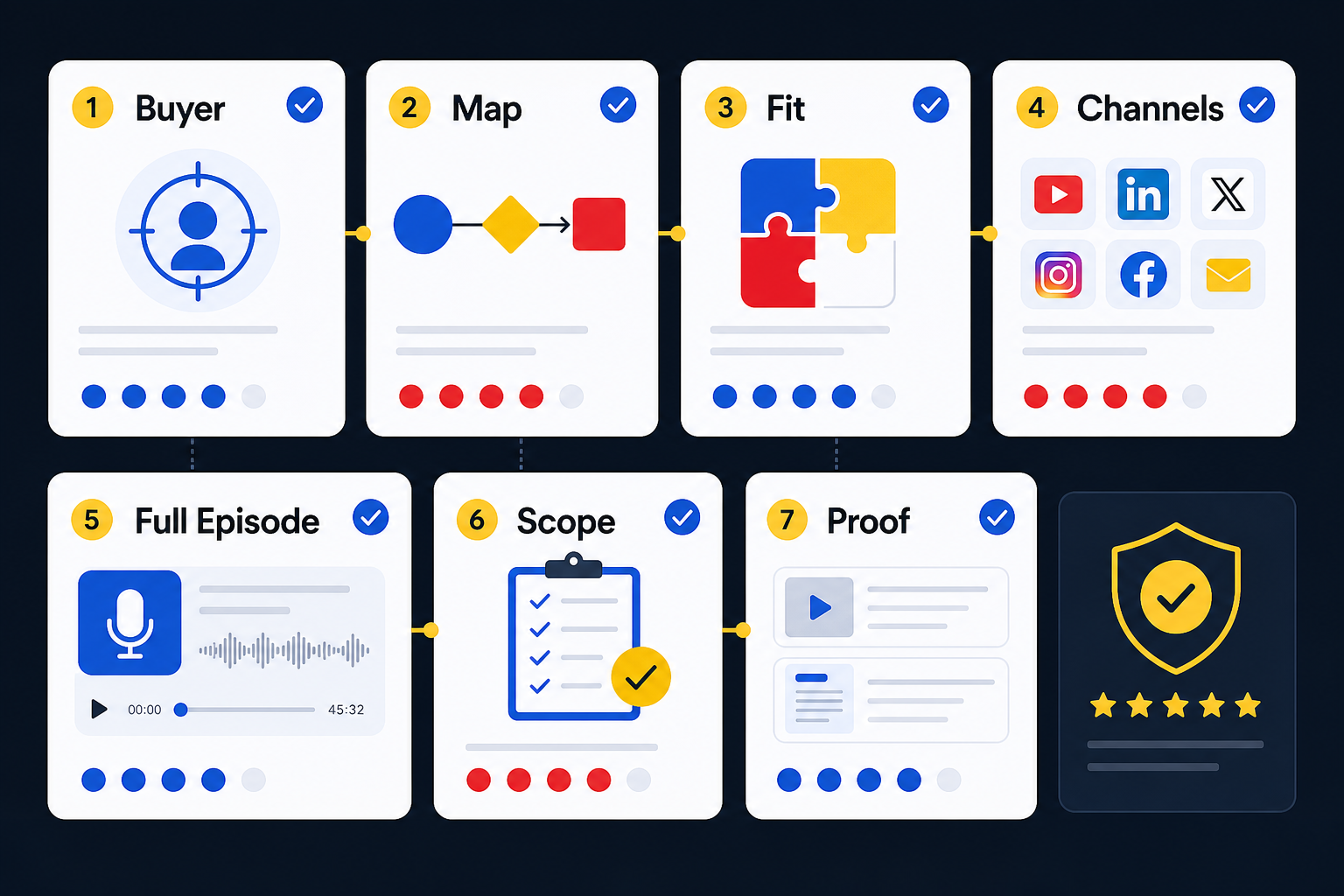
Use these seven questions before you hire.
- Do they ask about my buyer, offer, and business goal?
- Do they review the episode for proof, objections, and strong moments before editing?
- Do they explain why certain moments should become clips and others should not?
- Do they adapt outputs by channel instead of pushing the same asset everywhere?
- Do they help connect short assets back to the full authority asset?
- Do they show clear scope for writing, design, editing, publishing, and revisions?
- Do their case examples show business value, not only vanity views?
If you answer “no” to three or more, keep looking.
Start With The Diagnosis
Before you hire anyone, find out what your podcast actually contains.
Start with a Clip Opportunity Map. It helps you see which parts of your archive are worth turning into clips, posts, and articles first. It also helps you spot whether the real bottleneck is strategy, production, or source quality.
If the source material needs work, start there before scaling output.
Map before you edit.
Sources
- Edison Research, The Podcast Consumer 2025
- EpisodePack, Done-For-You Podcast Content Repurposing
- Content 10x, Podcast10x
- ContentFries, Content Repurposing Services