

Table of contents
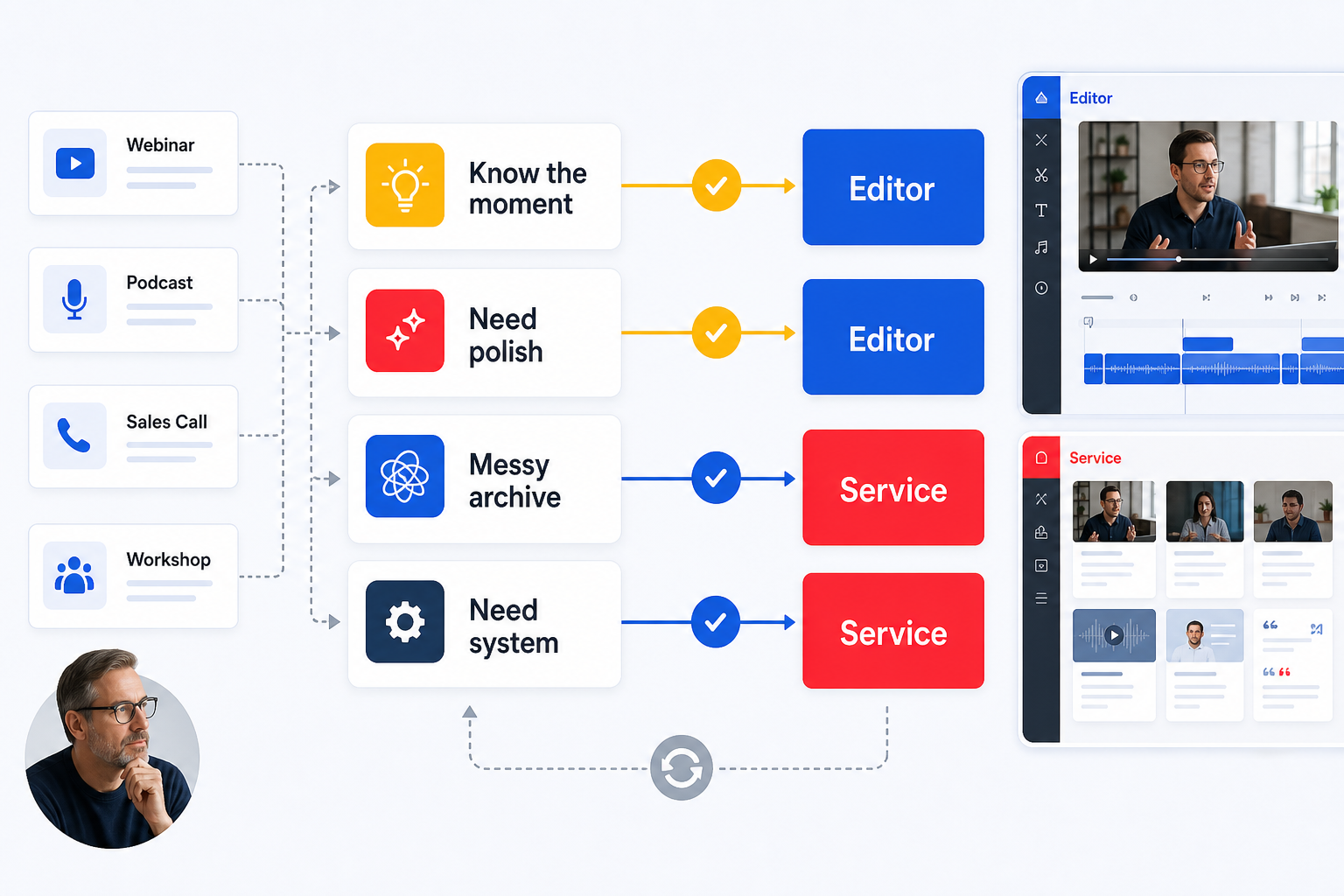
If you know what clips you need, hire a video editor.
If you have hours of video, but do not know what to use, you may need a content repurposing service.
That is the main difference.
A video editor makes a clear idea look better. A content repurposing service helps you find the right idea first.
This guide is not for creators who only want more clips or cheaper captions. It is for founders, business podcasters, coaches, consultants, B2B educators, and expert-led teams.
If your long videos should build trust, leads, and sales, this is for you.
The Short Answer
Here is the quick rule.
Hire a video editor when:
- you know which clips you want,
- you know the hook,
- you know the call to action,
- you only need cleaner cuts, captions, pacing, and exports,
- you can write the brief yourself.
Use a content repurposing service when:
- your archive is large or messy,
- the best moments are buried,
- your clips get views but not good leads,
- one recording should become many useful assets,
- you need help before editing starts.
The common mistake is simple.
People hire an editor when the real problem is choosing what to edit.
Why This Matters In 2026
Repurposing is now a normal marketing job. HubSpot’s 2026 State of Marketing report lists repurposing content across channels as one of the top marketing trends.
HubSpot’s marketing statistics report also says the top ROI content formats for marketers in 2026 are all video. Short-form video leads at 49%. Long-form video follows at 29%. Live-streaming video follows at 25%.
So teams feel more pressure to turn every webinar, podcast, demo, and founder video into clips.
But more clips do not always mean better marketing.
Content Marketing Institute’s 2026 B2B research found that content relevance and quality were the top drivers of better marketing results.
Teams still struggle with making content that gets people to act, working with limited time, and measuring results.
The numbers are plain. Creating content that prompts action is the top challenge at 40%. Resource limits follow at 39%. Measuring what works follows at 33%.
That is the key point.
Output is easy to buy. Good judgment is harder to buy.
Before you cut a clip, ask this:
Will this moment help the right buyer trust us faster?
That question should come before editing starts.
What A Video Editor Does
A good video editor turns a clear brief into a better asset.
They can:
- cut the video,
- remove dead air,
- tighten the pace,
- add captions,
- reframe for vertical video,
- clean the audio,
- add B-roll,
- export the right sizes.
That work is useful.
If you already know the best moments, an editor may be enough.
For example, you ran a webinar. You already know you want:
- one clip that handles a sales objection,
- one clip that proves your method works,
- one clip that tells a customer story.
In that case, the thinking is done. The editor can execute.
If you are comparing this with a broader done-for-you option, read our guide on DIY vs done-for-you content repurposing.
What The Market Sells
There are many useful tools and services in this space.
EpisodePack turns podcast episodes into show notes, blog content, and social posts. Recast helps marketing teams turn recordings into social-ready videos and other formats. Spoke is a content repurposing agency for webinars, podcasts, keynote talks, and other recordings.
These are valid options. But each one solves a different problem.
Some are built for fast production. Some are built for strategy. Some are tools. Some are services.
Before you compare prices, compare the thinking layer.
Ask:
- Who chooses the source?
- Who finds the best moments?
- Who writes the angle?
- Who checks if this fits the buyer?
- Who learns from results?
That is where many teams get stuck.
The market exists because the problem is real. Teams record more than they can use.
What A Content Repurposing Service Should Do
A content repurposing service should not only cut clips.
It should help answer:
- What source is worth using?
- Which moments show expertise?
- Which moments answer buyer objections?
- Which moments explain the offer?
- Which moments should become clips, posts, carousels, articles, emails, or sales assets?
- What should we learn before the next batch?
Most expert-led teams are not short on raw material. They are short on judgment.
A 60-minute podcast can include:
- one strong buyer objection,
- one useful framework,
- one proof story,
- one clear offer explanation,
- one weak tangent,
- five moments that sound good but do not help the business.
An editor can polish all of them.
Strategy decides which ones deserve to exist.
The Core Difference
A video editor improves the asset after the choice is made.
A repurposing team improves the choice itself.
That choice includes:
- picking the source,
- scoring the moments,
- matching moments to buyer problems,
- choosing the format,
- adapting the idea for each channel,
- tracking what worked.
If you skip this step, you may get more content with no clear direction.
When A Video Editor Is Enough
Use a video editor when the job is mostly execution.
This is true when:
- your content strategy is clear,
- you know your target buyer,
- the recording has clear highlight moments,
- you only need short clips,
- you can review edits fast,
- you do not expect the editor to plan the campaign.
Business podcasters may already know the repeatable clip types:
- the opening problem,
- the strongest quote,
- the guest proof story,
- the final takeaway.
If that format repeats every week, a good editor can move fast.
When A Content Repurposing Service Makes More Sense
Use a strategic repurposing partner when the job includes strategy, selection, and packaging.
This is true when:
- your archive has many long recordings,
- your best ideas are hard to find,
- your team keeps asking, “What should we post this week?“,
- your clips get views but do not help sales,
- your founder has strong ideas but no content system,
- one source should become many assets,
- you need a feedback loop, not just a folder of exports.
This often applies to:
- webinars,
- podcasts,
- coaching calls,
- workshops,
- founder videos,
- YouTube interviews,
- demos,
- sales calls.
The 2026 webinar benchmark report from Goldcast, promoted through AMA analyzed more than 26,000 webinars across 522 B2B groups.
That is a lot of long-form source material.
The same page says those webinars had 6.8 million registrants and more than 2.2 million attendees.
For many B2B teams, the problem is not recording more. The problem is getting more value from what they already have.
If your team already has webinars, podcasts, and founder videos, start with a clear content repurposing workflow. Decide which moments deserve production before you edit.
The Buyer-Relevance Test
Before you hire anyone, score the moment.
Ask these questions:
- Does this moment answer a buyer objection?
- Does it prove the method works?
- Does it make the offer easier to understand?
- Would it help before or after a sales call?
- Does it show real expertise?
- Can it become more than one asset?
- Does it give someone a reason to watch, read, save, reply, or click?
If a moment fails most of these questions, better editing will not save it.
If a moment passes, the clip has a job.
Use a quick score:
- zero or one yes: hire for execution,
- two or three yes: fix your process first,
- four or more yes: you likely need strategic help.
The Hidden Cost Of Hiring Only For Editing
A cheap editor can look like a good deal.
But someone still has to do the hidden work.
The hidden work includes:
- watch the full source,
- find the best moments,
- write hooks,
- choose the channels,
- write captions and post copy,
- request revisions,
- approve final assets,
- connect content to the offer,
- learn from results.
If your team already does this well, great. Hire the editor.
If the founder is the only person who can judge the content, you may create a bottleneck.
The editor waits for direction. The founder delays the review. The calendar fills with safe clips because nobody had time to think.
Energy does not always equal business value. A funny clip can still be the wrong clip.
Polish can also hide waste. A clip can look great and still lead nowhere.
That is how “we hired an editor” becomes “we still do not have a content engine.”
A Better Workflow: Map Before You Edit
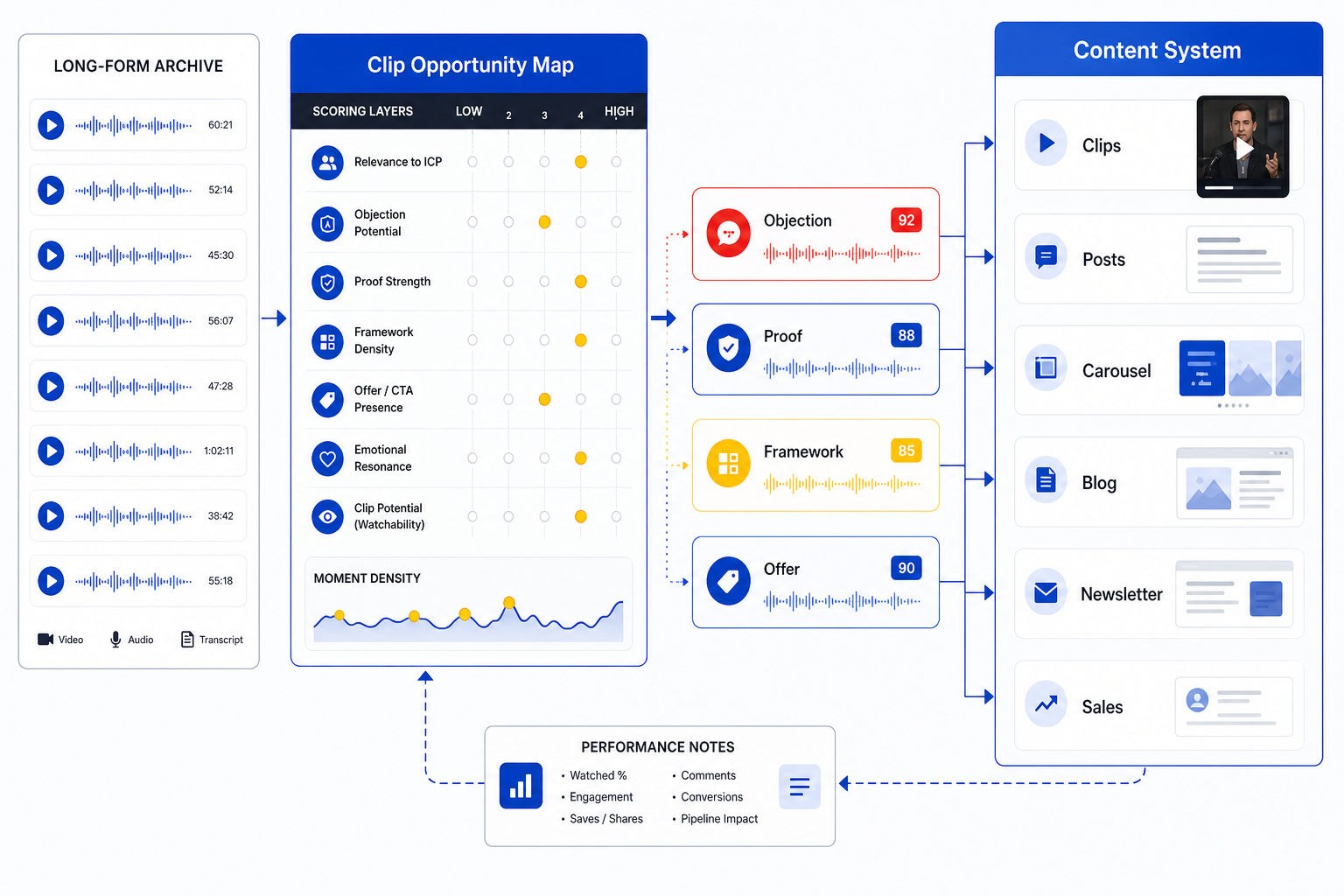
Before you buy a service, editor, or tool, map the archive.
Use this simple workflow:
- Pick one strong long-form source.
- Find every useful moment.
- Score each moment for buyer relevance.
- Choose the best three to five moments.
- Decide the job of each asset.
- Match each moment to a format and channel.
- Edit only the moments that passed.
- Track what created good engagement.
This avoids two bad paths.
One path is making everything because AI and editors make output easy.
The other path is making nothing because the archive feels too large.
The goal is not more clips. The goal is better choices.
For a practical example, read our guide on turning one video into a week of content. The key is the same. Choose the right moments before you scale output.
If you want to make this first step concrete, use a simple map before you hire an editor, buy a tool, or commit to a full service.
What A Good Content Repurposing Service Should Deliver
A strong service should give you more than files.
It should review the source material. It should score the best moments. It should explain why each moment matters.
It should also adapt the idea for each platform.
The production layer may include:
- short clips,
- written posts,
- carousels,
- blog angles,
- newsletter ideas,
- sales snippets.
The system layer should include a simple calendar and notes for the next batch.
For some teams, the right answer is a full content repurposing service. For others, it is a lighter map that tells your internal editor what to make.
That is why the first step should be diagnosis.
What To Avoid
Avoid a service that only sells volume.
Warning signs:
- “unlimited clips” with no selection logic,
- the same post on every platform,
- no buyer context,
- no offer context,
- no source scoring,
- no reason for each asset,
- no feedback loop,
- no difference between views and real demand.
Also avoid giving a normal editor a strategy job without saying so.
If you want them to choose moments, write hooks, understand your offer, and plan the channels, that is not just editing. That is strategy plus production.
Also avoid the cheap captions trap.
Captions matter. They make clips easier to watch. But captions are not a content strategy.
So, Which Should You Hire?
Hire a video editor if you know what deserves to be made.
Hire a strategic repurposing partner if you need help deciding what deserves to be made, how it should be packaged, and how it should support the business.
For a small expert-led team, the best path is often:
- Map the archive.
- Score the strongest moments.
- Turn the best moments into a small batch.
- Learn what attracts qualified demand.
- Then choose an editor, service, tool, or sprint.
If your archive has podcasts, webinars, lessons, demos, workshops, or founder videos sitting unused, do not start by buying more output.
Start by finding the moments worth sharing.
Start With A Map, Not An Editor
Paste a YouTube channel or long-form video into the Clip Opportunity Map.
It shows which moments are worth turning into clips, posts, carousels, blog angles, and a content system.
It is diagnosis, not a sales call. Then you can decide what kind of help you need.
Sources
- HubSpot: 2026 State of Marketing
- HubSpot: 2026 Marketing Statistics, Trends, and Data
- AMA: 2026 Webinar Benchmark Report Revealed
- Content Marketing Institute: B2B Content and Marketing Trends for 2026
- EpisodePack: Done-For-You Podcast Content Repurposing
- Recast: Content Repurposing for Marketing Teams
- Spoke: Content Repurposing Agency